Tsuchi-Pain Bakery

A bakery in Fukushima City…..Japan has a lot of bakeries.

Rice is the staple in Japan, but nowadays, people also like bread products–pastries, cakes, donuts and so on.

Japanese people have a tendency to buy less in quantity than Americans, but more of a tendency to buy really high quality.

That’s me and my husband. His birthday is on February twentieth. Happy birthday, Sweetie! He works hard for me and our son. And he’s got a heart made out of love.

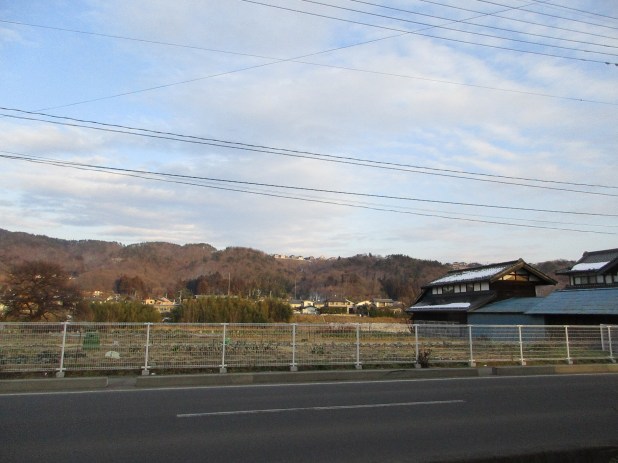
View from the bakery shop…

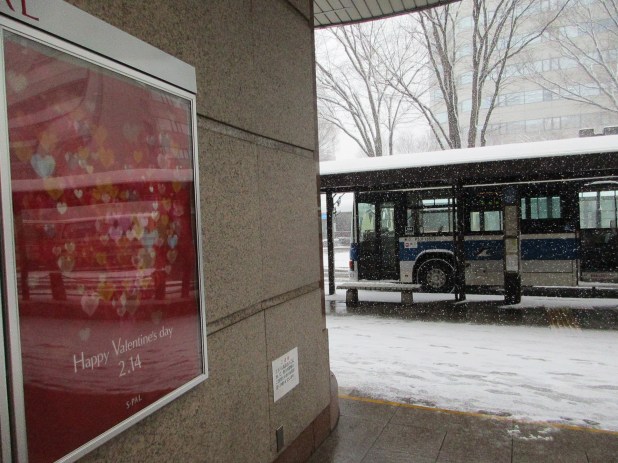
Happy Valentine’s Day

My mom recently asked me, “Does Japan have Valentine’s Day?”

Yes, Mom, it definitely does! Japan has embraced this western holiday, although tweaked it to make it their own.

On Valentine’s Day, women give out chocolate (usually)–to their significant other, to people who are important to them, to friends. When I first came to Japan, they would only give it to the men in their lives (their boyfriend, their dad, their male boss, their male friends, etc.) But now the custom has relaxed, and females sometimes give to females.

In March, there is White Day–a day when males give chocolate to the same women who gave THEM chocolate on Valentine’s Day. (My husband and I don’t do this, though. We exchange gifts on February fourteenth, like America.)

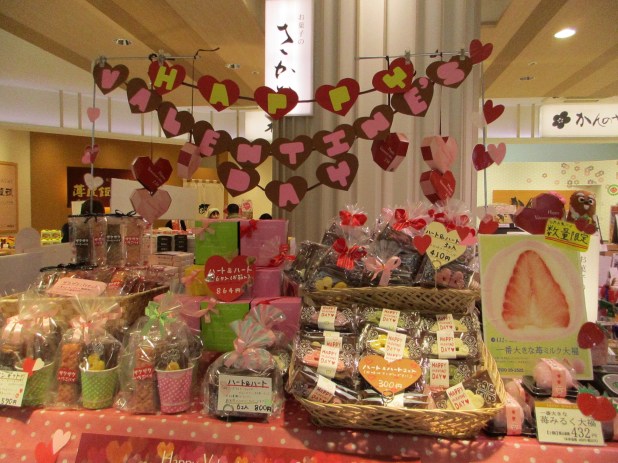
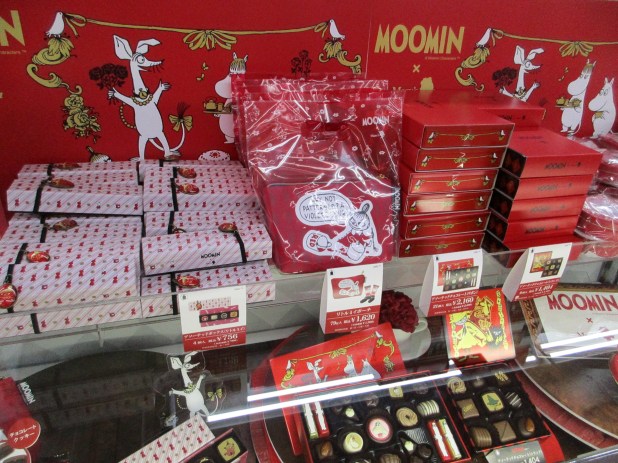
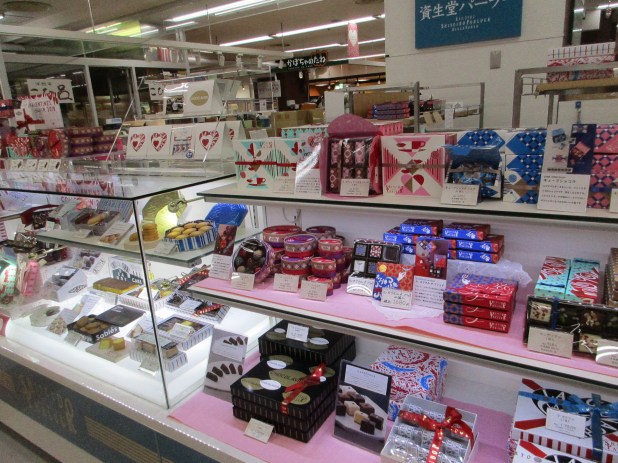
Valentine’s Day treats at SPAL (the shopping center connected to the train station.) I got permission for all photos.

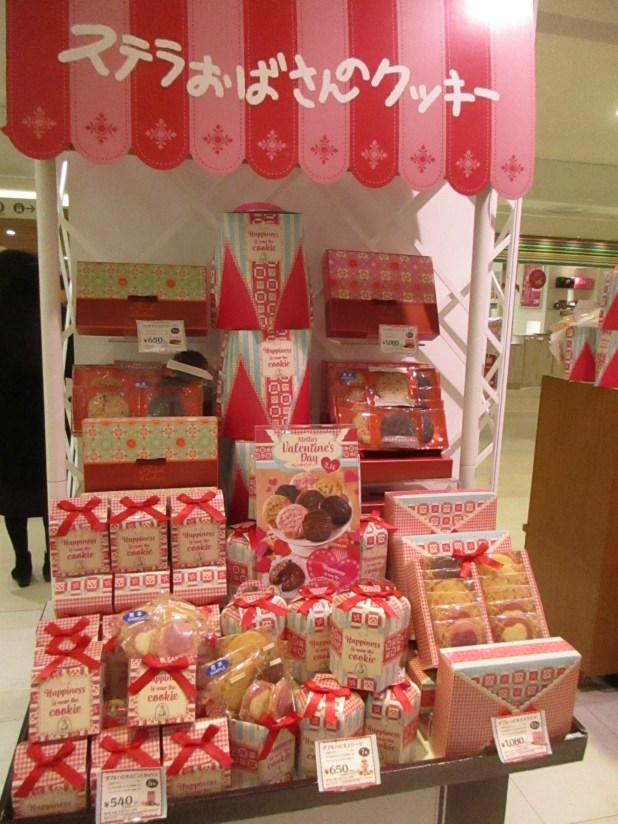
Valentine’s cookies at SPAL.

The photo above (and all remaining photos) are at Nakago, the department store across the street from the train station.

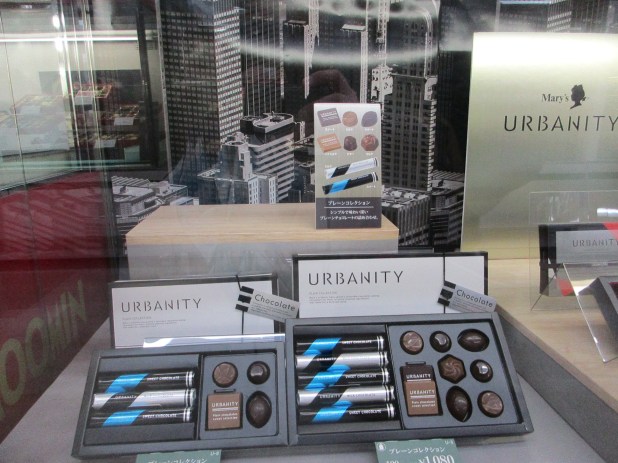
Notice how masculine the packaging is.It’s specifically for Valentine’s Day. (You can’t buy these chocolates in Fukushima City except in the Valentine season.) The masculine packaging is because chocolate makers know that typically women give the chocolate to men. So this would be for a manly man sort of man.

More manly man chocolates.

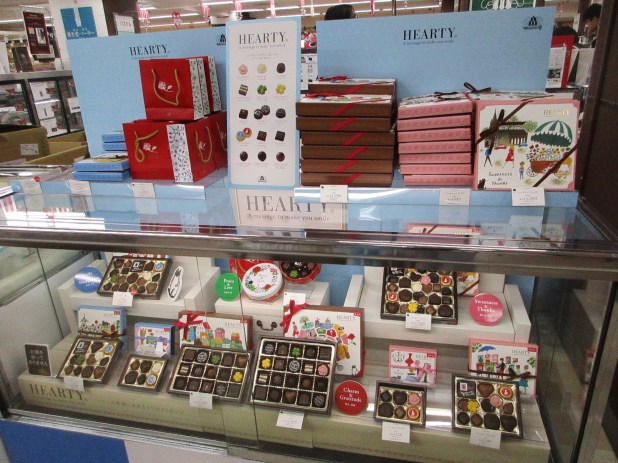
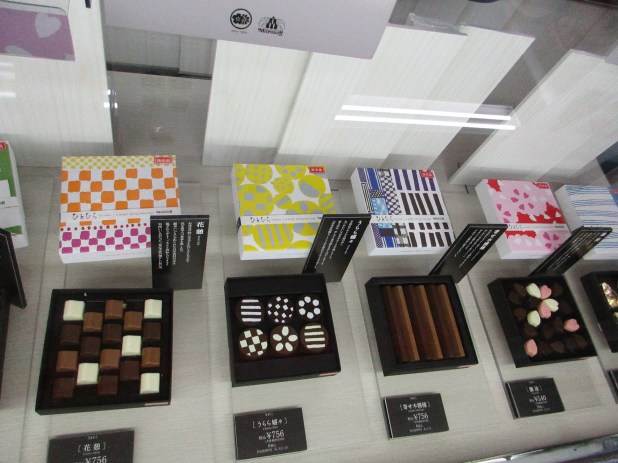
More chocolates. Not all of the chocolates have manly man packaging. There are MANY different styles. This is only Fukushima City, but in a place like Tokyo…whew! LOTS AND LOTS OF CHOCOLATE STYLES!!!!!

Not only are the chocolates manly man, but the man who created them is manly man.  (Nicolas Bernarde created them.)

Again a manly man–Francois Gimenez–created them.

These chocolates are Godiva.

These chocolates are not for your boyfriend or husband. These would be for your child or for your fun best friend.

Obviously not manly man chocolates. Fun and funky chocos.

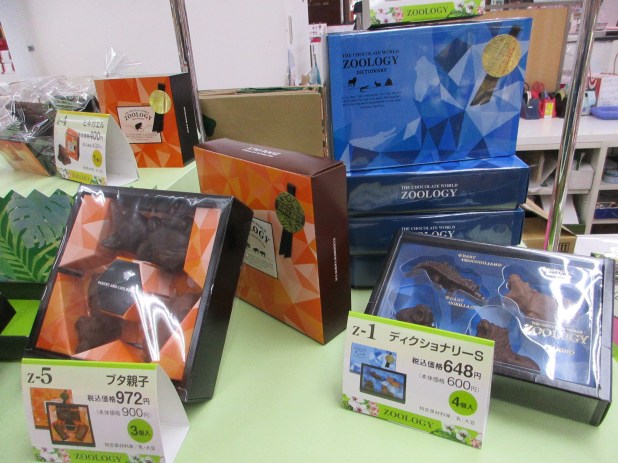
For the zoologist in your life.

For the crocodile wrangler in your life.

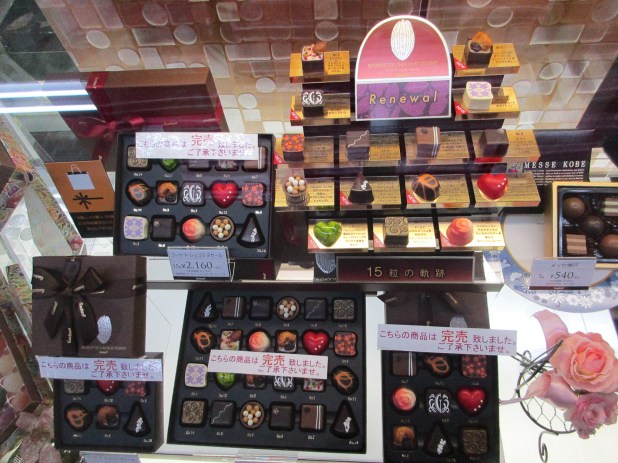
The signs says, “Sold out.” If a person waits until the afternoon of February thirteenth, a LOT of chocolates will be sold out. (I took all these photos on the morning of February twelfth.)


I’ve heard that Valentine’s Day is when the most chocolates are sold in Japan. Other things are sold as Valentine’s Day (mostly liquor, for the men who prefer that over chocolate) but usually it’s chocolates that are given on Valentine’s Day.

2020 Tokyo Olympics

As I write this in February of 2018, the winter Olympics have just begun in South Korea.

Do you know where the 2020 Olympics will take place?

That’s correct. In Tokyo!

Hosting the Olympics games in Tokyo is considered by many Japanese people to be a great thing, but there are also many Japanese people who are not pleased about it at all, for various reasons.

One big reason that people are unhappy is because Tokyo is overhauling itself to accomodate the games. An extremely famous fish market (Tsukiji Fish Market) will be moved. It’s been in its location for a long time and most people are not at all happy about its relocation.

Street signs are being changed to make them more understandable for non-Japanese speaking (or reading) foreigners. The traditional sign for Buddhist temple is being changed because Hitler based his swastika off of it (he reversed an ancient Asian symbol) and most foreigners don’t understand this.


There will be Olympic baseball games in Fukushima Prefecture. Fukushima won the chance to host these baseball games as part of the revitalization of the area.

Fukushima added as Tokyo 2020 Olympic baseball, softball venue

The Olympic baseball games are slated to be held at Fukushima Azuma Baseball Stadium, which is southwest of Fukushima City. (I say “slated” because I wouldn’t be surprised if the government changes its mind at the last minute, wanting to keep us Fukushimers happy until the last possible moment and then switching the venue over to, of course, Tokyo.)

There are some articles online that say the Olympic baseball games should not be held in Fukushima. “Anti-nuclear activists denounced the move. They argued that it created a false impression that Fukushima had returned to normal and glossed over the remaining hardships faced by an estimated 120,000 residents who still cannot – and may never – return to their homes. This is a snippet from the following article:

http://www.independent.co.uk/news/long_reads/fukushima-disaster-tohoku-japan-sports-baseball-basketball-olympics-recovery-a8134566.html

Basically, this type of quote says to me: Anti-nuclear activists never, ever, ever, ever, EVER want me and the other people of Fukushima to have the tiny bit of happiness or chance of revitalization.  Due to the meltdowns, Fukushima should be a place of misery and gloom and sadness, perpetually.

The baseball stadium is southwest of where I live. It’s not in the exclusion zone. Is the baseball stadium area safe, meaning that radiation levels there are safe? Yes, I believe so. It’s something that can be measured…and not only by the government, but by ANYBODY who has a measuring device like a dosimeter.


It makes me sad when I see that anti-nuclear people seem to want the people of Fukushima to suffer even more than we have already.  The more Fukushima suffers, the more it helps their agenda. So they want us to needlessly suffer even when we don’t have to.

Anti-nuclear people and the people of Fukushima really do want the same things. So it’s sad when people who are supposed to be on the side of Fukushima actually are wishing for the unhappiness of the entire prefecture.

Yes, there are people who are displaced by the tragedy, and their homes are in ruins. It’s extremely, extremely sad, and a huge problem. But baseball games in Fukshima Azuma Baseball Stadium won’t affect this situation. If anything, baseball games in Fukushima only help these displaced people, by calling attention to Fukushima, and thus to their plight.


UPDATE:

I forgot an important point, tangentially related to the disaster in Fukushima, but more related to the entire disaster along the Tohoku east coast, caused by the tsunami. MANY people in Japan were/are against the Olympic games in Tokyo because they feel that money is needlessly being spent on a huge two-week party in the capital city–when there is still much to be done to help the communities of Iwate, Miyagi, and Fukushima (and other places.)  Olympics are expensive to host, and it’s a point of national pride. Should Japan being spending money on them? Some people think yes–the games are fun and they’ll boost morale. Other people think no–they are much too expensive.

Ohnoya Candy Store

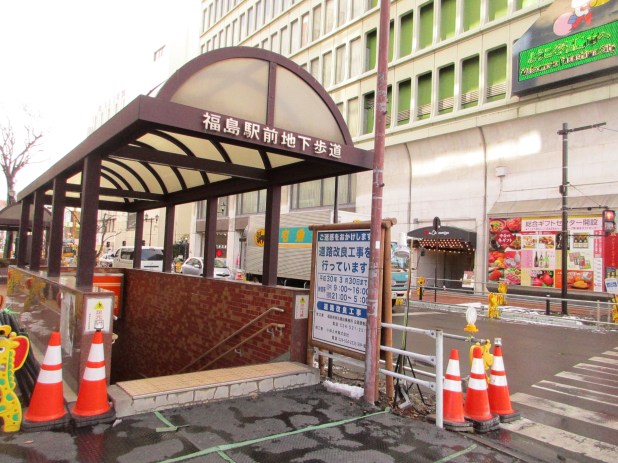
In front of Fukushima City station, east exit. Go down the stairs.

Turn left.

And buy candy!

Ohnoya sells traditional candy Japanese. It’s hard candy, and LOT and LOTS of flavors. Green Tea. Brown Sugar. Mint. And more. Yum.
This store is so easy to miss. But it’s so easy to get to from the train station!!!!!


Spring is here!

When I first came to Japan, I was very surprised that spring traditionally begins on February fourth. However, it’s been explained that this is indeed spring…the earth is preparing to open up and grow new life.

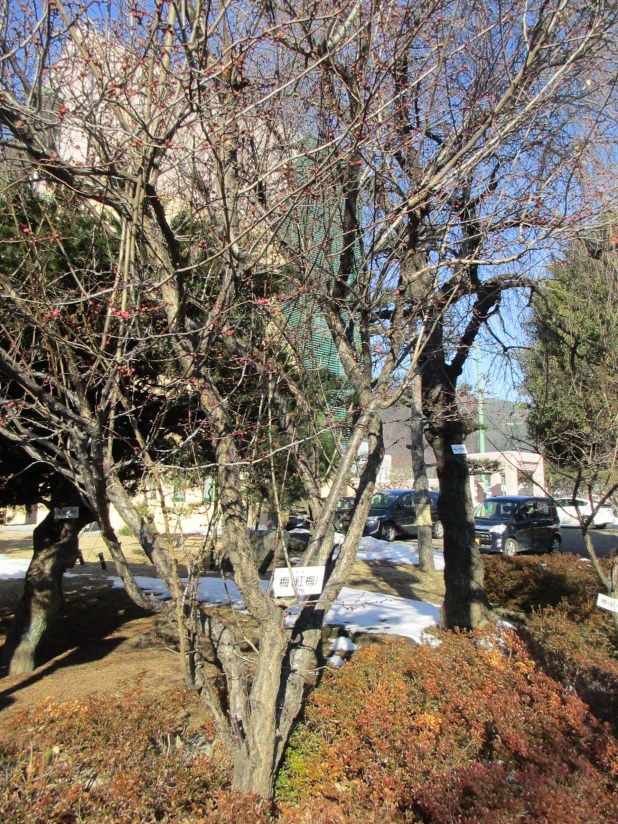
I’m not a farmer or a gardener…but take a look at this photo.

This photo shows a plum blossom tree. I took the photo yesterday morning (February fourth.) Plum blossom trees are early bloomers in spring. They don’t get the attention of cherry blossom trees, but neverthless they are a strong part of Japanese culture.

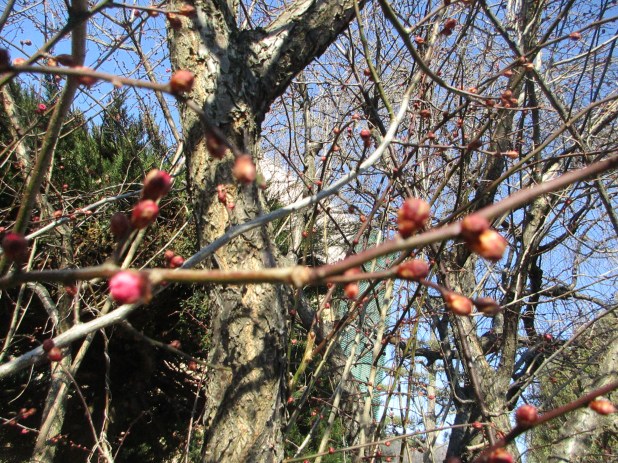
This is a close-up of that plum blossom tree. You can see that even though it is early February, it has started budding. So for traditional Japanese people, that meant that spring was here.

Yes, it will probably snow again. (In fact, we had a dusting of snow this morning.) But despite the cold, new life has begun.

Fukushima City Farm Products

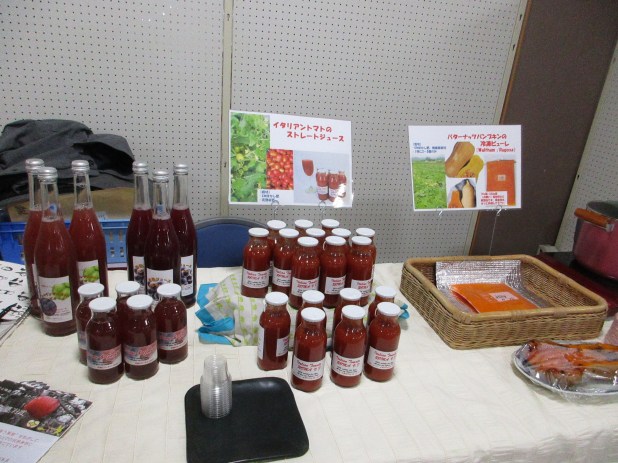
I happened to come across this event for farmers in Fukushima City. The sign says: “Fukushima-shi Nousanbutsu Shoudankai.”

Fukushima-shi=Fukushima City

Nousanbutsu=agricultural products

Shoudankai=Business talk meeting

It’s not meant for the public. It’s a meeting of those in the business of agriculture (in Fukushima City.)

However, they were very nice and allowed me to come in and chat with the farmers there. I got permission for all photos.

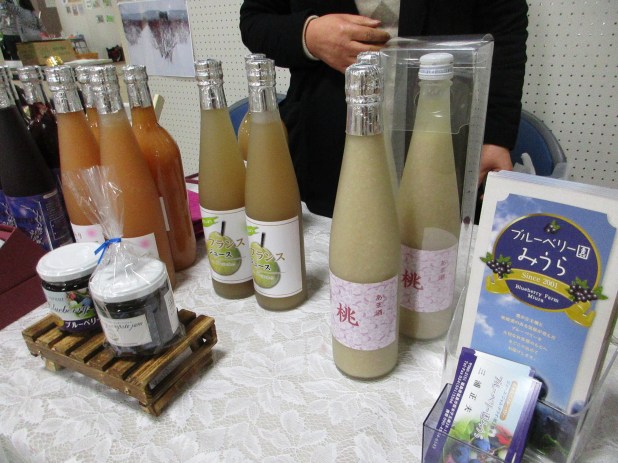
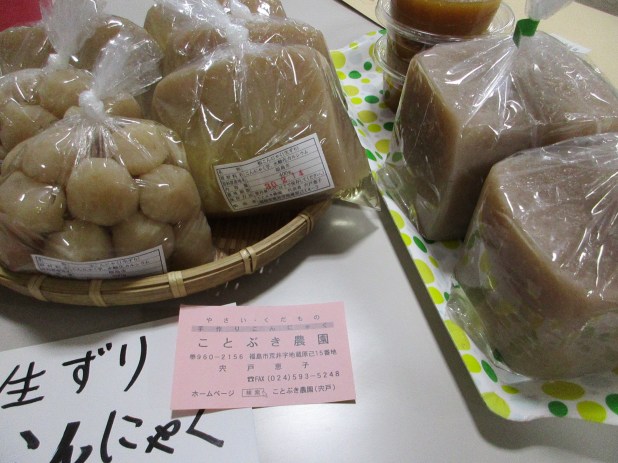
I chatted with various farmers, the ones who make the high quality food products shown in the photo. They look great, don’t they? There was a lot more on display, but the presentation started and I felt I should leave, not being a farmer myself. (Although I was invited to stay.)

In the last photo, the woman farmer who was at the table told me that she is from Namie Town. I knew that Namie Town had been evacuated (due to the nuclear meltdowns) and she said yes, they had to evacuate, leaving their farm. They came to Fukushima City (which was not evacuated.) They started their farm business again in Fukushima City. I admire this woman very much.

Fukushima has always been known for its excellent agriculture–wonderful food products. That’s its “thang.” So when the meltdowns occured, it simply ruined the wonderful repuation of Fukushima’s farming. I’m not a farmer, of course, but it’s something I feel bitter about.

So many people on the net nowadays say such nasty things about Fukushima food, often without knowing anything at all.  Anybody who says these things callously is not a good person.  It’s fine to have discussions, to have opinions–opinions against or for nuclear energy, opinions about the safety of food grown in the Tohoku area, opinions about anything. But to say things callously is not something anybody should do.

Callous: insensitive; indifferent; unsympathetic

A person who is unsympathetic to the plight of Fukushima’s farmers, and to the plight of Fukushima itself should get off their electricity-consuming computer and get a life.

news article: Tepco sucks

Tepco (Tokyo Electric Power Company) had the chance to test the Dai ichi nuclear power plant to find out what would happen if a tsunami occured….but Tepco turned down the opportunity. So basically, using the parlance of the younger generation, Tepco sucks.

http://mainichi.jp/english/articles/20180130/p2a/00m/0na/017000c

refused in 2002 to calculate the potential effects of tsunami in case of an earthquake off Fukushima Prefecture

https://www.japantimes.co.jp/news/2018/01/30/national/japan-scrapped-proposed-fukushima-tsunami-simulation-nine-years-disaster/#.WnKnaExuJ14

In the spring of 2008, Tepco conducted a simulation and concluded that tsunami as high as 15.7 meters could hit the Fukushima plant. But the firm still did not take action before the 2011 disaster, instead saying the simulation was based on a hypothetical scenario and that there was no evidence suggesting such powerful tsunami would actually engulf the Tohoku region.

Here’s what I think.

Tepco is a Tokyo company.

The people who make the decisions at Tepco live in Tokyo.

The people who make the decisions at Tepco do not live in Fukushima.

And THAT’S why they did not take action.


The first day of spring…. is February fourth! Yes, it’s true! (According to the traditions of Japan.)

The first day of spring–traditionally–in Japan is February 4th.  Winter is considered over, and new life is starting. Maybe we can’t see the new life-it’s there budding deep in the earth, below the snow. The snow will soon melt to make way for this new life to flourish.

However, the day BEFORE February 4th is–traditionally–the last day of winter. Setsubun is on February 3rd, and Japanese people ritualistically cleanse their homes of evil spirits.

img_3168

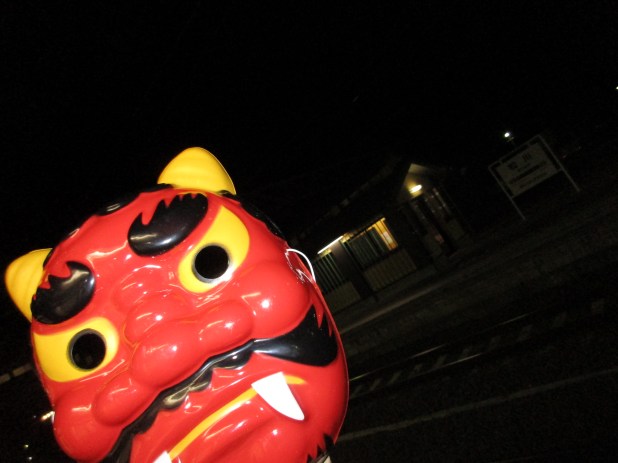
This mask is a mask for Setsubun–it’s an oni. “Oni” is a word that can NOT be accurately translated into English.  Often it is translated as “devil” but if you are thinking of Satan, well, it’s not the same.

The “Oni” is also a monster of sorts–like a troll. It appears in fairy tales, and makes those fairy tales difficult to translate into English, because westerners don’t know the concept of “oni.” Even though Japanese people understand European-based fairy tales (they are popular here), the majority of Americans do not understand (nor read) Japanese-based fairy tales.

img_3200

These photos were actually taken on February 3rd last year (2017.) I saved them to show you this year.

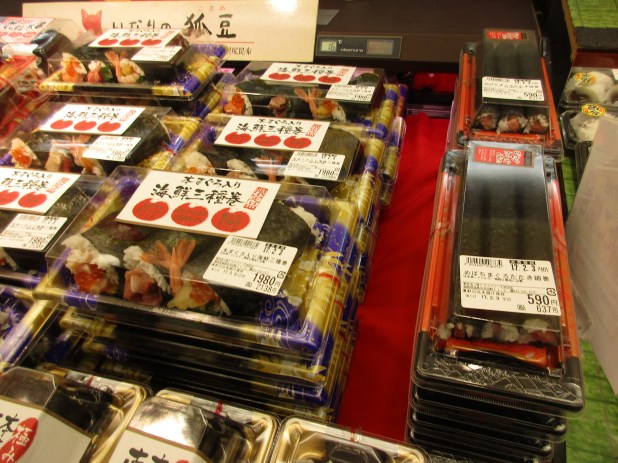
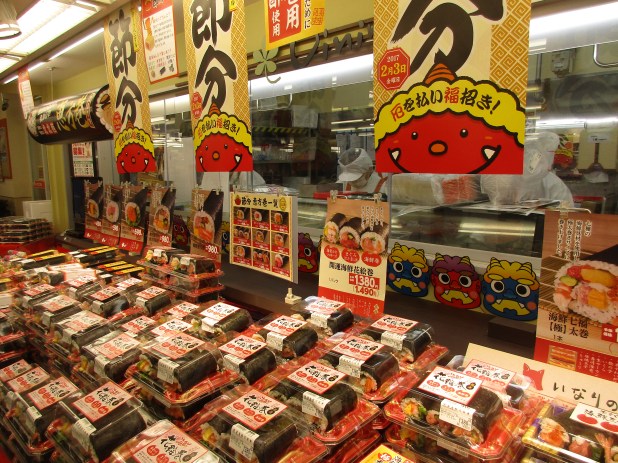
A new tradition in Japan is to eat these rolled sushi on Setsubun Day. The tradition comes from down south (the Kansai area, where Osaka is). My husband doesn’t follow this tradition because he is not from Kansai. (He is from Tohoku.) However, stores all over Japan have picked up on the tradition of eating this sushi on February 3rd…and nowadays people in Tohoku eat them. (Except my stubborn husband.)

img_3201

You can see from the store displays, that even though an oni is involved in Setsubun, it’s a cute oni. An frequntly has a horn or two and fluffy hair–blue or black or red or green or yellow.

img_3203

The sushi for setsubun, called “ehoumaki.”

img_3205

Ehoumaki sushi is big and fat, and you are supposed to eat it without talking, while facing a certain direction. (The direction changes every year.)

img_3206

The store normally does NOT have ehoumaki for sale like this! This is for Setsubun…they know that many moms and dads will purchase them. KACH-ing! (The sound of a cash register.)

Some people also make the sushi at home.

img_3207

Beans which are thrown at the Oni. (One person pretends to be the Oni–usually a dad or maybe a mom–and the kids throw beans or peanuts at him or her. That’s why you can get Oni mask–the person who pretends to be the Oni will cover his or her face with the mask.


img_3208

The paper masks are free. I think you have to buy beans or peanuts? But I think nobody really cares if you just grab one.

illustration taken with permission from irasutoya.com


If you want to make your own Oni mask, then you can watch this video that shows one way of making the mask–from a tissue box. It’s in Japanese, but you can figure it out by watching it.

Which power plant melted down, and which was shut down safely? Answers revealed…

Sadly, the answers (to the quiz in the previous post) are obvious.

The first photo shows Dai Ichi, which had three meltdowns.

Following a major earthquake, a 15-metre tsunami disabled the power supply and cooling of three Fukushima Daiichi reactors, causing a nuclear accident on 11 March 2011. All three cores largely melted in the first three days.”  from this link:

http://www.world-nuclear.org/information-library/safety-and-security/safety-of-plants/fukushima-accident.aspx


The second photo shows Dai Ni which was shut down safely, and continues to be shut down.


The following is a link to a Huffington Post article in Japanese. (I can not find a similar one in English.)

http://www.huffingtonpost.jp/2016/03/10/fukushima-daiichi-nuclear-power-plant-2016_n_9412886.html

The first two photos compare a part of Tokyo (left) to the Dai Ichi Power Plant area (right.)

The second picture (a diagram) shows the levels of radiation at Dai Ichi Power Plant from February of 2016, four years after the disaster.

The third pictures show the exclusion area (the “forbidden zone” as it is commonly called) in size compared to Tokyo (right side.)

The fourth photo shows Dai Ichi Power Plant in 2016.

The fifth photo shows meals available to workers—I guess the workers trying to repair the mess.

The sixth photo shows a convenience store for those workers.

The next photo shows “Facings” (I have no idea what those are, but you can see them in the photo) in the larger photo. The inset photo shows the way it was before the accident, a grassy hill.

The next few photos show the disaster area that the Dai Ichi Power Plant is now…….

And the last photo is Tokyo. Lovely, isn’t it? Or is it? The last photo is of the lights of Tokyo (one of the largest cities in the word), and it is included in the article because the Dai Ichi Power Plants supplied the electricity for those lights. The Dai Ichi was one of Tokyo’s power sources. I don’t personally put any blame on the people of Tokyo–I use electricity, too. Obviously. But I always reiterate that the Fukushima Dai Ichi Power Plant supplied electricity to Tokyo (Not Fukushima!) because I get very much tired of Fukushima being blamed for the disaster, either directly or indirectly, especially on the internet.

google———Fukushima Dai Ichi and Dai Ni Power Plants

Before the 3/11 earthquake and tsunami, there were two nuclear power plants in Fukushima, both on the coast. (Nuclear power plants must be near a source of water.) Both were/are owned by the Tokyo Electric Power Company (TEPCO) and supplied electricity to Tokyo.

ONE of the power plants was fine, and was safely shut down. The other one had meltdowns. Look at the Google map views. Which do you think was the power plant that melted down? Which was the one that was safely shut down?

Guess.

First, Dai ichi. (Literally: Power Plant Number One)

https://www.google.co.jp/maps/place/東京電力+福島第一原子力発電所/@37.421336,141.0258896,826m/data=!3m2!1e3!4b1!4m5!3m4!1s0x6020dd3801b3fc69:0xa6090708f3cbc4cd!8m2!3d37.421336!4d141.0280783


Second, Dai Ni. (Literally, Power Plant Number Two)

https://www.google.co.jp/maps/place/福島第二原子力発電所/@37.3165974,141.0221696,761m/data=!3m1!1e3!4m5!3m4!1s0x6020de2dbb45d145:0xacb6b3b41ca75df7!8m2!3d37.3165693!4d141.0249493


If you know you know your numbers in Japanese—-Ichi, Ni, San, Shi, Go (One, Two, Three, Four, Five) then the names make sense.

In kanji, these numbers are: 一二三四五