Art Saori Plus (Weaving)

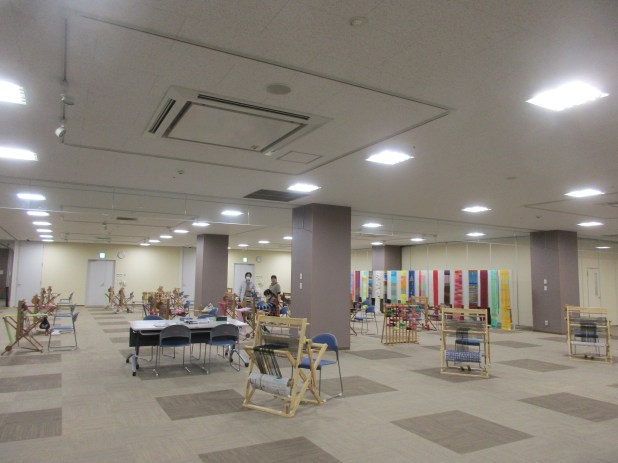
Close to the Fukushima train station, there’s a department story called DaiYu 8 Max. And on the fourth floor of that department store, there’s a whole floor devoted to study, exhibits and so on. This is where my Wednesday Japanese class is held. Well, last Wednesday, Fukushima’s Art Saori Plus was holding an exhibit of its store’s woven items.

I felt that the items were so gorgeous.

This area was very interesting to me. I could watch a professional weaver. Furthermore, I had the chance to sit down and try weaving for myself. It was interesting! I loved this opportunity. Arigatou, Art Saori Plus!

Elementary School Yomikikase–Eric Carle’s “Dream Snow”

The other elementary school library volunteers asked me to do a book for the first and second graders. Knowing that it would not be read to the older kids, I chose an Eric Carle book. Like most people, I love Carle’s books, but I have avoided them for yomikikase (reading aloud to students) because I feel their subject matter is usually too babyish for the fifth and sixth graders.

My mother had sent me his “Dream Snow” back when my own son was a toddler, so I chose it. The Japanese version is (as always) from our local library.

I know my illustration of a farm is impressive…but I copied it off an image I found on the internet. LOL, I enjoy drawing, but I’m certainly no professional.

This book was a huge hit, and I was requested to also read it to the special education class and to the kids at the public preschool next door. If you’re wondering–yes, Japan does Christmas. But it is the secular variety, not the religious variety.  Most people here are not Christian, but they’ve borrowed a lot from western culture in recent years, and traditions of Christmas is one cultural aspect that has been borrowed.

I enjoy books and I enjoy kids, so I enjoy being a library volunteer!

Friday Japanese Class End of the Year Party!

My Japanese teachers are so very kind to give their time to help us non-native Japanese speakers. They are all such very good people!!!! ❤ My Japanese level wouldn’t be as good as it is without them, and my knowledge of Japanese culture would not be as thorough, either. I owe so much to them!

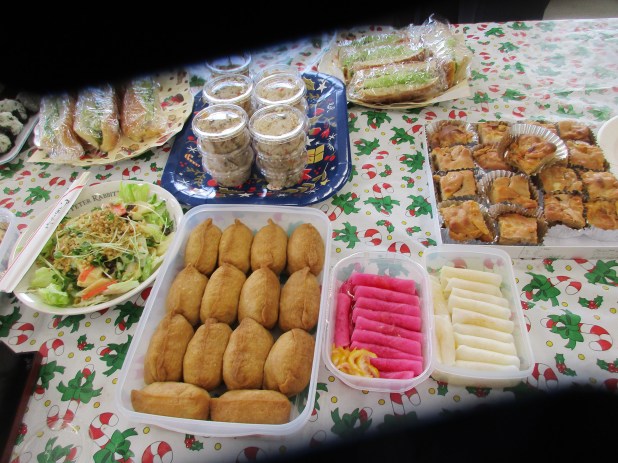
The following photos are from today’s party.

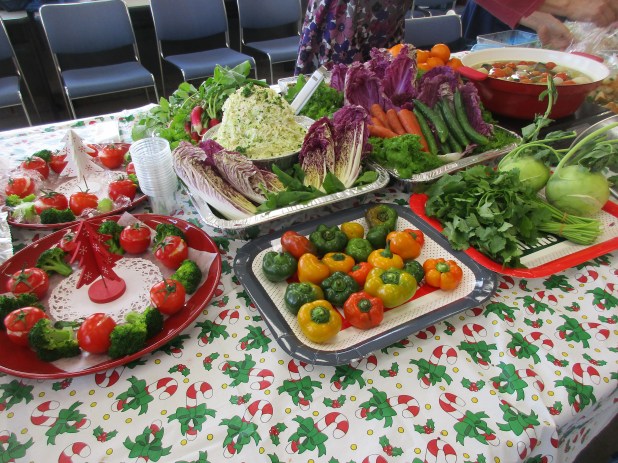
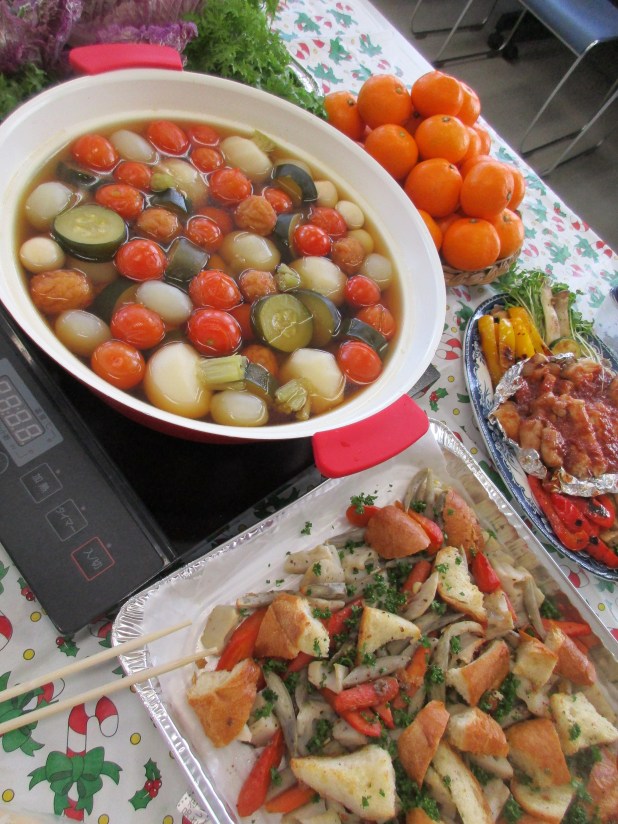
My male Japanese teacher is a great cook. He attends cooking classes! His food was so popular.

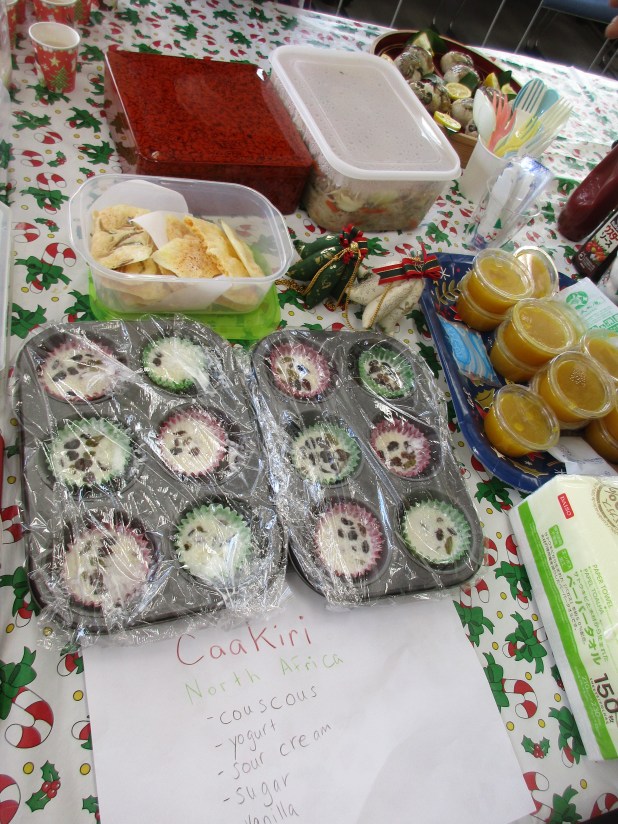
I made a couscous pudding with a recipe that I got off the internet. The reason I chose this is because we have high school students who are living here to play basketball–and they are from North Africa. So I wanted to try to give them something that is common in their own country.

The wafers in the box were made by my husband. He makes these “cheese sembei” for me and my son, so I asked him to make them for the party. It’s a simple recipe!

A woman who works in a bookstore always goes all out! She’s a fantastic cook.

This squid and carrot dish is an extremely famous dish of our region (Fukushima.) The note reads that it is Fukushima Taste Made by a Real Fukushima Person. My male teacher made this (and yes, he is a born and bred Fukushimer!)

His wife made AmaZake. Literally, “sweet sake” but there’s no alcohol so kids can drink it.

Presents!

Happy Holidays! A huge thank you to all the people who work so hard to help out us non-Japanese people in Japan.

My N1 Test is finished…!

I took the N1 Noryoku Shiken (It tests the abilities of foreigners in the Japanese language) on Sunday afternoon. It’s over! Yay! I won’t get the results until February of 2019.

These are the items I prepared prior to the test. I needed my test voucher, HB pencils, erasers. The eraser must be slipped out of its case.

I also brought a watch. The room has no clock. My phone is there–it must be turned off during the test.

Snacks for the breaktime, but I didn’t end up eating them.


N1 is the hardest of the five levels for the test. At this very high level, everybody in the room is very good at Japanese (if not–that person should not have chosen to take the test. Level N5 is for beginners in the Japanese language.) Many of the test takers are college students from various Asian countries. Everybody in the room was Asian, mostly Chinese and Vietnamese. I think the only other native English speaker besides me was a young man from New Zealand. (I talked to him briefly.)

I don’t think I passed, but I do think that with more study, I could eventually pass. That’s a nice feeling.

I don’t know if I’ll be posting a lot. I have avidly been working on my writing of manuscripts. I’d like to get them published.

So take care, everyone, and have a great December!

Exhibit of Art by famous Fukushimer (and extremely talented) Sato Gengen

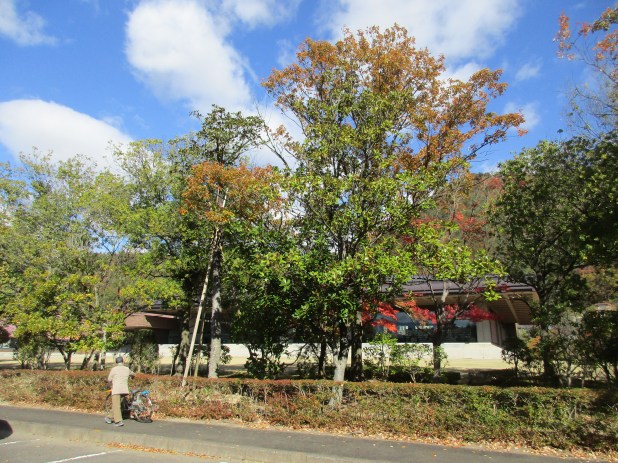
I needed to return books I’ve used for my job and for my volunteer work. Also, I wanted to borrow books for research for the manuscript I am now working on.  In the photo, you can see Fukushima Prefectural Library.
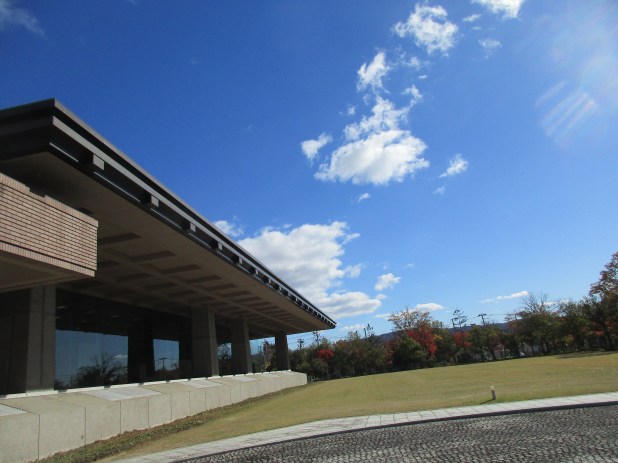
My apologies for the slanted horizon. When I took the photo, I was concentrating on getting the front of the library plus the trees in the distance. You can see the leaves changing, although so far our weather has been very mild. (Too mild, in my opinion.)

See the front windows? During the Big Quake of 2011, they shattered completely. (I know this because the library has photos of the damage done by the quake.)

Because we are inland, though, Fukushima City’s buildings were NOT affected by the tsunami. The city is very far from the coast.

After the library, I headed next door to the Fukushima Prefectural Art Museum. I go to all its exhibits because I purchased a one-year pass. (A good deal!)

This exhibit was amazing! (I could not take photos inside the actual exhibit. In the photo, I am in the lobby.)

It was mostly statues and woodwork. The artist was born 130 years ago in what is now Fukushima Prefecture’s Soma Town. I asked if this artist is famous all over Japan, and was told that he is. After I saw his work, I definitely believed it. His work is fantastic!

I was told that though he grew up in Fukushima, he left for college in Tokyo. Then he studied in Paris. The first part of the exhibit appeared non-Japanese–it looked influenced by European and Egyptian art. But the end of the exhibit was definitely Japanese-influenced. I can’t describe it, but I loved it.

There was one section that had sculptures of animals—and I had flashbacks to a zoo when I looked at a lizard basking on wood in a glass case! That made me think that it would be interesting to sculpt small animals (lizards, snakes, frogs) and display them in cases–like an actual herpetarium. That would be fun.

Here’s more info about Sato Gengen. (If you are wondering, Gengen–a cool name–is not his birth name. Like many Japanese artists and writers, he changed his own name to a pen name.)

https://www.gurutto-fukushima.com/detail/783/news/fukushimaguide-90730.html

Gonna Take Hardest Level of Japanese Language Proficiency Test

I received my test voucher yesterday so I’m all set!

Luckily, the testing venue is just down the street from my home.

It’s a test for foreigners to gauge their Japanese ability. It’s basically reading, grammar and listening skills.  (I don’t have to write or speak.)

I don’t know many people who have passed it. It’s very difficult for a non-native speaker of Japanese.

I’ve passed N2 (the second hardest level.) N2 is generally what is required to get a job in the field of Japanese.

This is my first time taking N1 and I don’t expect to pass it. My knowledge just isn’t there. I’m taking it more to go through the motions and get a good feel for the test.

School Book Reading….

As a library volunteer, I go to the classrooms and read picture books to the students. But once a year, all the volunteers get together and we read a picture book together to all the students in the school.

The library volunteer leader chose Leo Lionni’s “Little Blue and Little Yellow.” I read it in English, alternating page by page with volunteers who read it in Japanese.

I did not make the blue and yellow circles! The leader made them.

It’s held in the gym, and kids watch the story on a screen as we read it.

My reward afterwards….Snack Time!!!!!!!!!

recent article about Fukushima tourism

This article is in a non-Japanese newspaper:

https://www.theguardian.com/world/2018/oct/17/there-is-hope-here-fukushima-turns-to-tourism-after-nuclear-meltdown?fbclid=IwAR3fT8ziHVIqula2PaiW9XyhT9oPbfJMs-ZP-oUQoHU7S07HgGk-EwsYR_U


My quick thoughts:

1.) “Turning to” is not the right word. Pre-accident, Fukushima was a very popular place for Japanese people to go. It’s got history, onsen, beauty….What this article is talking about foreign tourists, who were very much unaware of Fukushima before the accident. Fukushima is not trying to “turn to,” rather, we are trying to get back to how we used to be (a relaxing getaway.)

2.)  “Fukushima Brand”??? Ugh…  Fukushima is not a “brand.” It’s a place.

Taking a blogging break….

My husband and I celebrated our twentieth anniversary in September of 2018. We were married (first) in Kansas on a hot September day, then we had a second ceremony in October for his parents’ side.

He’s an extremely good person, and a great husband. ❤


I signed up to take the highest level Japanese Proficiency Language Test (in December, 2018.) So I am going to stop blogging for a while to concentrate on studying for that. I might pop in every so often for urgent news reports, but basically I’ll be Nihongo-ing.

And as always, I’m writing jotting down penning  banging out my work-in-progress. It’s terces pot, which in Backwards Language means…. Well, we need a Backwards Language Dictionary to correctly translate it. It’s difficult to define.

Okay, signing off for the next three months……….

Have a great autumn! (or spring, for those below the equator)